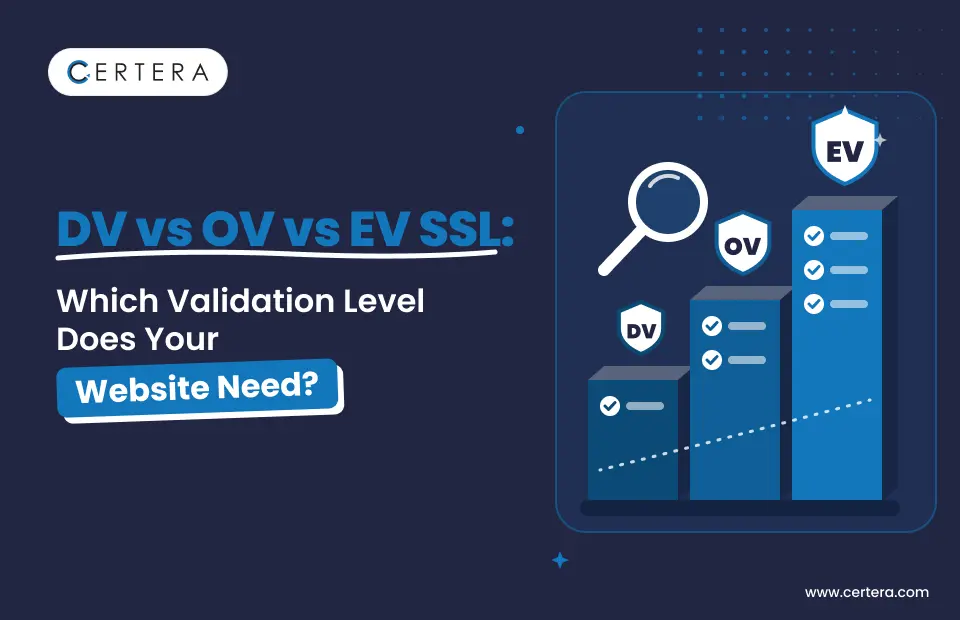
Choosing the right SSL certificate depends on Domain Validated (DV), Organisation Validated (OV), and Extended Validation (EV). Most site owners know they should use HTTPS, but aren’t sure which level is best for their site. This guide simplifies the muddle by outlining the facts of the different levels and guiding you to the appropriate one.
DV SSL is the right choice for most blogs, personal sites, and small businesses. OV SSL is more appropriate for those who want to display confirmed business information.
While its level of identity security is the greatest, its use is more often necessary on a standard website that currently doesn’t need it in 2026. All three certificates come with equal strength of encryption. There is only a difference in the level of audit that the certificate authority provides of your organisation.
Domain Validated SSL vs OV vs EV: What Each Level Actually Checks
- The certificates that are called ‘Domain Validated (DV) certificates’ only confirm that you own the domain. The certificate authority verifies this via email, DNS, or a file on your server. Data fields for Companies are not verified.
- Organisation Validated (OV) certificates are just one level above. They attest to control of said domain and then to basic organisation data: legal company name, address, and contact details. This helps to make the relationship between domain and business more understood.
- Extended Validation (EV) certificates have the strictest process. The certificate authority fully audits the organisation before issuing the certificate to make sure that they are legally in existence, physically present, and operating.
The strength of the encryption remains the same for all three levels. There is no difference other than the level of identification initially conducted prior to issuing the certificate.
Does the Padlock Look Different for DV vs OV vs EV SSL? Setting Expectations
Google and all other browsers don’t mark the EV certification on their address bars anymore. Years ago, this functionality was taken from Chrome, Firefox, Edge, and Safari.
All SSL certificates, including DV, OV, and EV, display the same padlock in the address bar. At first glance, users do not notice any difference.
Details about the organisation for OV and EV certificates are still accessible upon clicking the padlock. They will be able to see identity information, including the verified company name. For the majority of visitors, however, these differences are not noticeable, and many visitors do not notice or read these details.
How Long Does Validation Take: Domain Validated SSL vs OV vs EV
Typical DV validation time is a few minutes to a couple of hours. It is mostly an automated process after successfully proving domain control.
Normally, the OVs will take 1-3 business days for validation. You need to make sure that your company details are correctly verified and you don’t have any missing documents or unsure contact information will make it slow.
The processing time for EV validation takes 3–7 business days or more. It includes more in-depth legal and operational investigations, and the most frequent delay is the lack of documentation.
If you’re looking to ramp up any level, you can do so by prepping domain access and company records. Routine complexities, whether it is a complex ownership situation or if the contact is not available, tend to get timelines pushed out.
Also Read: Free vs Paid SSL: The Hidden Dangers of Free SSL Certs
DV vs OV vs EV SSL Comparison Table
Look through and do the comparisons below, so you’ll be able to quickly identify each of the options and match each to your site’s requirements.
| Validation Level | What Is Verified | Issuance Time | Visual Difference in Browser | Best For | Relative Cost |
| DV | Domain control only | Minutes to a few hours | Same padlock as others | Blogs, personal sites, small businesses | Lowest |
| OV | Domain control + basic organization identity | 1–3 business days | Same padlock; company details visible on click | Sites that want verified company information shown | Medium |
| EV | Thorough checks on legal existence and identity | 3–7+ business days | Same padlock; company details visible on click | Rare cases needing maximum identity assurance | Highest |
The benefits and drawbacks of these choices are readily apparent in this comparison. Most websites do not benefit from anything after implementing DV or OV.
Which One Do You Need For Your Site? A Decision Guide
Small informational websites, personal sites, and blogs should begin with DV. It provides everything you need in encryption without paying extra for it. It is not an expensive or time-consuming thing to have with regard to encryption.
Speculations are better avoided with OV, as visitors to a business website will only be interested in confirmed company information if the website has an OV. The additional validation establishes a more solid link between a domain and the organisation behind it.
For large enterprises, financial institutions, and sites which carry high-value transactions, EV may be warranted where full identity may be a real need. Deeper checks ensure lower chances of impersonation in high-risk settings.
Caution: do not select EV just to get better Trust Signals or SEO rankings. All three levels are rendered the same in browsers, and search engines don’t give sites more weight for EV certificates. Choose a level suitable to your audience and/or compliance requirements.
Common Myth: Is SSL higher ranking than Domain Validated SSL or look more secure?
- EV certificates don’t have any benefit on search rankings. DV, OV, and EV certificates are equal in SEO ranking from Google and other search engines.
- Unlike before, browsers don’t show a green address bar to alert users about EV certificates. All three validation levels are the same for the padlock.
- It is the content of the site, the customer reviews, the contact information, and the reputation of the website that build user trust, and not the SSL validation level itself. The majority of visitors either don’t check the certificate details or simply do not visit it.
Conclusion
Most websites do not require DV SSL. Use OV when you are certain that your visitor is an actual member of the organisation or that you need to comply with a particular requirement that forces your choice to be OV.
Use EV only in certain situations of high assurance, like big banks and other institutions. Choose according to real needs and not according to old-fashioned notions of what is a ‘trust signal’ of a kind that visuals give or ‘good for SEO.
Related Reading: Certificate Life Cycle Management: Emerging Trends to Watch in 2026
Frequently Asked Questions (FAQs)
1. What’s the difference between DV, OV, and EV SSL?
With DV SSL, you just have to prove you are in control of the domain name. OV SSL includes additional organisation verification to verify details like company name and address. The checks carried out by EV SSL are the most rigorous for legal existence and identity. The three levels have the same encryption strength. The only difference is the extent of the certificate authority’s validation of the organisation that owns the site.
2. Is domain validated SSL as secure as OV or EV?
Yes. The three certificates offer the same level of encryption strength; all three provide the same level of protection for data on transit. The only difference is that the identity verification of the certificate owner is greater or less. DV verifies domain validation, and OV/EV do more, validating the organization itself.
3. Will the OV and EV certificates have green bars in the address bar?
EV Certificates are no longer displayed as a green address bar in modern browsers. Many browsers have gotten rid of this visual cue in recent years, including Chrome and Firefox. All certificates (whether DV, OV or EV) display the same padlock. Details of the organisation of OV and EV remain hidden until a user clicks the padlock.
4. Should EV SSL be worth the added expense in 2026?
In most cases, no; EV certificates are issued for a much higher value, take more time, and are processed the same as DV and OV certificates by most browsers. For For large enterprises, financial institutions, or high-value transaction sites with a particular need for the strongest identity assurance, EV is helpful, albeit not extensively.
5. Is there a way to switch basic SSL valid on domains later to OV SSL?
Yes. It is possible to apply for a new OV certificate and replace the DV certificate at any time. No matching digital certificate is available to upgrade to. Just replace the old OV certificate with the new one on your server, and the change becomes effective immediately upon removing the old certificate.