Introduction
Owing to the advancement in technology, hackers are never idle as they continue to look for new ways that they can use to penetrate and gain unauthorized access to people’s information.
Among these up-and-coming threats is vishing, or voice phishing, a form of social engineering wherein the attacker uses the force of his or her oratory skills via phone calls or voice recordings.
In the context of these emerging threats, it is essential to explicate the differences and related characteristics of vishing and typical phishing schemes to distinguish this type of fraud.
What Is a Vishing Attack?
Vishing is one of the subcategories of phishing and is a type of social engineering attack where the attacker uses telephonic communication to make the victim divulge information or perform some activity as per the attacker’s directives of the attacker.
While phishing mostly focuses on the technical sides of communication like email, vishing focuses on another aspect, thereby using a voice that is more authoritative and earns the trust of the victim.
In traditional vishing situations, the attacker pretends to be a trusted entity like a bank, a governmental institution, or a technology support center. This way, they have the ability to use techniques like caller ID spoofing to make sure that the call appears to be coming from a trusted source, which makes it that much easier for them to dupe the intended victim.
The major idea of the scam is to purposefully get the targeted person to send personal details such as login credentials, credit card details, or any other useful information that the scammer could desire.
Vishing risks come in different types because vishing involves different techniques, including the use of scripts, which are prerecorded messages that are played to the victims.
At times, the attackers may even try to penetrate the victim’s system through phishing, where a link is created from the URL that directs the victim to a different webpage that has classical malware, or by posing as a sender with the intention of making the victim download a file that contains classical malware.
The vishing attacks are unique due to the usage of voice communication, which is more natural and less suspicious compared to other forms of communication that involve text, as people tend to trust words and voice over the phone.
Vishing vs Phishing: Distinguishing the Critical Differences
While vishing and phishing share similarities in their ultimate goal of obtaining sensitive information through deception, several key differences set them apart:
Communication Channel:
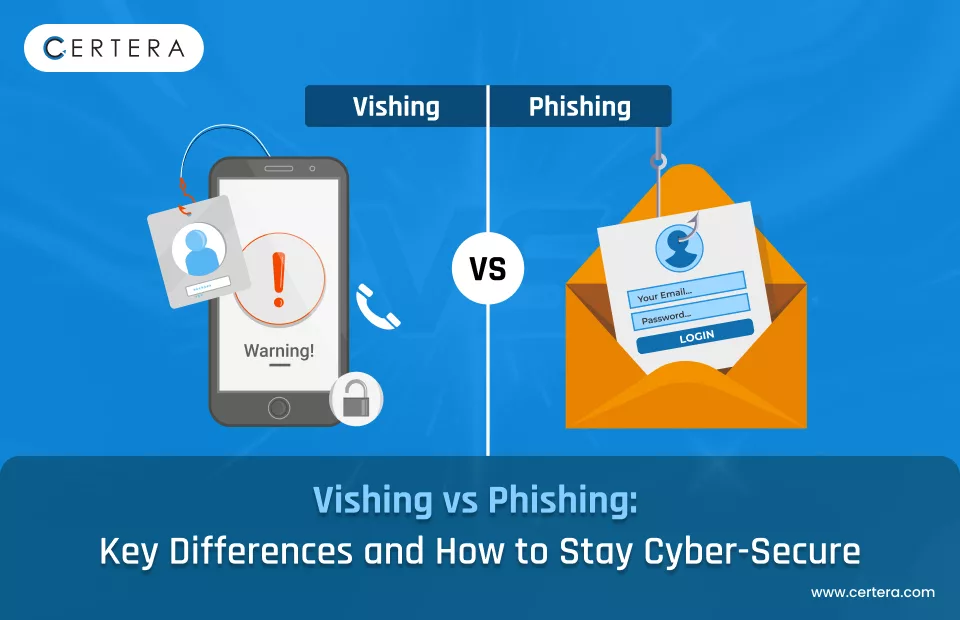
Phishing and vishing are actually similar but have some differences: namely, while phishing commonly uses messages through email or instant messaging, or Web-based links, vishing gives preference to phone calls or voice messages.
With this, the type of attack vector affects psychological effects and the success rate of the social engineering approach used.
Social Engineering Approach:
There is usually the use of urgent or evacuated language, the use of authority, or the reliance on fear to force the victims into action without rationality.
Vishing attacks, on the other hand, take advantage of people’s familiarity with phone conversations, thus making it easier for the attacker to convince the victim by making them believe that he or she is of higher authority, say an official call from the hospital.
Victim Response:
In phishing attacks, victims are usually asked to click on a link or an attachment. For example, in the case of the compromised Twitter handle, users were directed to enter their credentials, which they did unknowingly, leading them to either install malware or share their credentials with the attackers.
Unlike phishing attacks, where victims are directed to a website to surrender their personal information, vishing involves a more personal and convincing tone over the phone, whereby victims are tricked into revealing information verbally or into making actions such as transferring funds or entering a new account detail.
Attack Vector:
Phishing is different from other types of attacks in that it can affect a large number of people with a relatively small amount of effort and preparation, as compared to mass mailing campaigns or website compromises.
Vishing attacks, on the other hand, are always more specialized in that the attackers are more or less likely to speak directly to their victims, while making the whole process more tiring, it is also likely to have more credibility because the attacker will be ‘talking’ to the victims.
Psychological Impact:
Despite their effectiveness, phishing attacks are entirely based on emails, and thus, their messages often try to establish a sense of fear or something like that, which can be easily identified as a phishing attempt.
While vishing attacks are not as scary as phishing attacks, the latter is more psychologically affecting as people can be stopped or tricked into the attack via voice conversation, hence increasing the chances of the vishing attack.
Also Read: What is Quishing(QR Phishing)? Common Attacks, Vulnerabilities, and Prevention
How to Protect Yourself from Vishing Attacks?
While vishing attacks can be highly convincing, there are several steps you can take to protect yourself and your organization from falling victim to these scams:
Strategy 1:
Do not trust phone calls from unknown persons, especially when the caller is asking for personal data or something that may look like an emergency.
Organizations, especially the authentic ones, will not demand such details as may be in the phone genuinely or without due notification or for a reason that cannot be questioned by the persistent caller.
Strategy 2:
You can save yourself by asking for the name of the person calling, their department/office, and a number where you can reach them back; after this, verify the information given by checking with the official body the person claiming to be from.
These precautionary measures make the request real and not fake, as the details obtained should be from authenticated contacts, not those relayed by the caller.
Strategy 3:
Never disclose to any caller your phone, credit card, or account number without verifying the phone number’s legitimacy, and only if you placed the call. Regarding a call that contains a request for some personal data, you should simply answer ‘no’ and hang up if the call is unexpected, too bad, or coming from somebody unknown.
Strategy 4:
They come up with fake emergencies or fake representations of risky situations to fool the receiver of the call into either parting with cash or disclosing personal information that the caller desires.
It is impossible for legitimate organizations to use such manipulative approaches and will always offer time for you to use relevant referential materials to gauge their authenticity.
Strategy 5:
It is also important that one should familiarize oneself and the organization with the current vishing cases and the threats that are aggressive. Conduct routine assessments of your security measures and ensure all your workers are aware of how a vishing scam works and how they can counter it.
Strategy 6:
Use it as guidelines for major changes: Consider activating MFA or two-factor authorization for critical accounts and operations. This is an added barrier insofar that even if the password is given out using the vishing technique, the attacker will still have to follow the steps of the algorithm to reach the desired location.
Also Read: Rockstar 2FA: A Growing Threat in Phishing-as-a-Service
Strategy 7:
If you feel that you have joined the vishing victim group, you should immediately change all the affected passwords or account details and inform the police, banks contributing to the scam, and institutions represented by the attacker. Preventing any further actions will be helpful to reduce the risks and further abuse by him or her in question.
Special Tips for Organizations
Harden your organizational culture by fostering skepticism and being wary of internal and or external threats at your workplace.
Encourage workers to challenge unauthorized attempts to gather personal data with the same approach as they should promote checking the authenticity of any compelling requests, as the goal is to make security concerns a collective responsibility for the company.
Conduct rigorous risk analyses and amass effective security measures that should be periodically reviewed because of ever-increasing risks. This could entail limiting the availability of large databases, using higher levels of security when a computer is in use, and occasionally scanning to see if there are any apertures that hackers could wiggle through.
To improve protection against vishing attacks, it is possible to consider employee training and awareness, so that the personnel know the newest methods of social engineering.
This is one way through which regular training is useful, as it keeps people on guard and adhering to better practices to avoid these potential threats, thus making the training proactive in nature.
To stay up-to-date on how attackers are using vishing to exploit people, continue to read future articles on authoritative cybersecurity websites as well as tweets from cybersecurity specialists.
Cybercrimes are dynamic, growing in intensity and expanding in the strategies they use to attack their targets. This means you have to remain informed and vigilant for the best chance of protecting yourself.
Set up systems that allow people to report when they, or another employee, has been exposed to the virus. Designate employees to vishing or security breach reporting lines for the two threats to be apprehended and dealt with accordingly in the organization.
It is advised to employ call monitoring and recording facilities in sensitive departments or positions, especially to detect and research instances of potential vishing attacks or to subpoena the records for legal procedures.
Find ways through which your organization can prevent vishing attacks. Some suggestions include the following. Your organization should review and update the incident response plan to cover vishing attacks and other social engineering threats. This will assist the team in reducing complex segmentation and time to contain damages and prevent the exploitation of successful attacks.
Promote a security awareness that respects the confidentiality of secure data and employs the efforts of an employee to look for suspicious activities, such as vishing exercises.
Conclusion
Vishing scams are increasingly common in the threat landscape, leveraging the unsuspecting user’s trust in the communication channel provided by voice. As with common phishing scams, vishing has been around for some time, but vishing takes the scam to a different level since it employs the ability of human interaction.
It is clear from the preceding sections that vishing and phishing are similar in some ways but different in others, and that through careful action carried out by individuals and organizations, including paying attention, actively verifying information, raising awareness, and adopting security measures against these social engineering techniques, it is possible to prevent your or other individuals’ or organizations’ data from being attacked.
Frequently Asked Questions
What is the Primary Goal of a Vishing Attack?
The main objective is to get the targets to provide personal or business details such as usernames and passwords, credit card details as well as other important information through telephone calls or voice messages.
How can I verify a caller’s legitimacy?
Start by asking their name, their department, and the number they would like you to call back with, and then verify that information alongside an official lookup using a source of contact information that is known to be accurate for that organization.
Is it ever safe to provide personal or financial information over the phone?
It is dangerous in most instances unless you have dialed the contact of a verifiable and reputable person. When registering for membership, customers are not usually requested to input their personal or sensitive information.
Can Vishing Attacks Lead to Malware Infections?
Yes, for a particular type of cyber threat like phishing, the attackers may try to force the victim to visit the URL of the web page or download the file, and make them vulnerable to the particular malware or any other dangerous cyber threats.
How can Organizations defend against Vishing Attacks?
The measures that need to be employed are putting strong security measures, training employees, involving them in a practical manner, having a vigilante culture, having call monitoring and incident response plans in place, and always updating on new vishing modus operandi.