As businesses and organizations ramp up their utilization of digital certificate systems, there arises a need to be able to verify certificate-related data in an efficient manner, without subjecting large datasets to a cumbersome verification process again and again.
Merkle Tree Certificates (MTCs) use cryptographic hash trees to create compact and verifiable representations of data while providing efficient proof of integrity and membership in them. This makes Merkle-tree-based methodologies very important for modern WebPKI, certificate transparency, auditing, and certificate management.
This guide aims to explain what MTCs are, how they operate, the approaches used in their generation and verification, fields of their applications and best practices for use, and how they differ from usual digital certificates and signatures.
What is a Merkle Tree Certificate?
A Merkle Tree Certificate (MTC) is a cryptographic structure leveraging Merkle tree technology in order to provide a compact and verifiable way to prove the integrity and authenticity of certificate-related data. Instead of relying on a single hash or a traditional certificate chain, the MTC represents a wide range of data in the form of a tree of hashes organized hierarchically.
At the uppermost level, the Merkle tree creates a Merkle root, a compact form of all the tree’s information. Whenever there is an adjustment, the whole sequence of hashes is changed, including the Merkle root; therefore, any unauthorized changes are noticeable.
The application of Merkle tree technology is particularly helpful in modern WebPKI systems because they require certificate transparency, efficient management of certificate processes, and scalable validation.
What This Means for the WebPKI and Certificate Management
The system of WebPKI uses digital certificates to create a trustworthy environment for websites, users, browsers, programs, and services. As certificates are becoming valid for shorter time periods and the number of available certificates increases, it is necessary to find the most effective means to monitor and confirm certificate data.
The use of Merkle trees may help to solve this problem since one root hash may identify several databases of certificates, but each certificate can be verified at the same time.
In terms of certificate process management, this is beneficial for several reasons:
- Effective Integrity Verification: Certificate records can be validated in an easy manner without going through the entire database.
- Possibility to scale Data Validation: Large inventories of certificates can be represented through compact cryptographic commitments.
- Ability to identify Tampering: Modifications to the certificate-related information can be detected through hash comparison.
- Use of Effective Proof: The verifier can use a Merkle proof without the need to get the entire dataset.
- Better Transparency: Companies can keep verifiable records of certificate information.
Therefore, MTCs are part of movements towards a more transparent, automated, and cryptographically verifiable WebPKI infrastructure.
How Merkle Tree Certificates Work
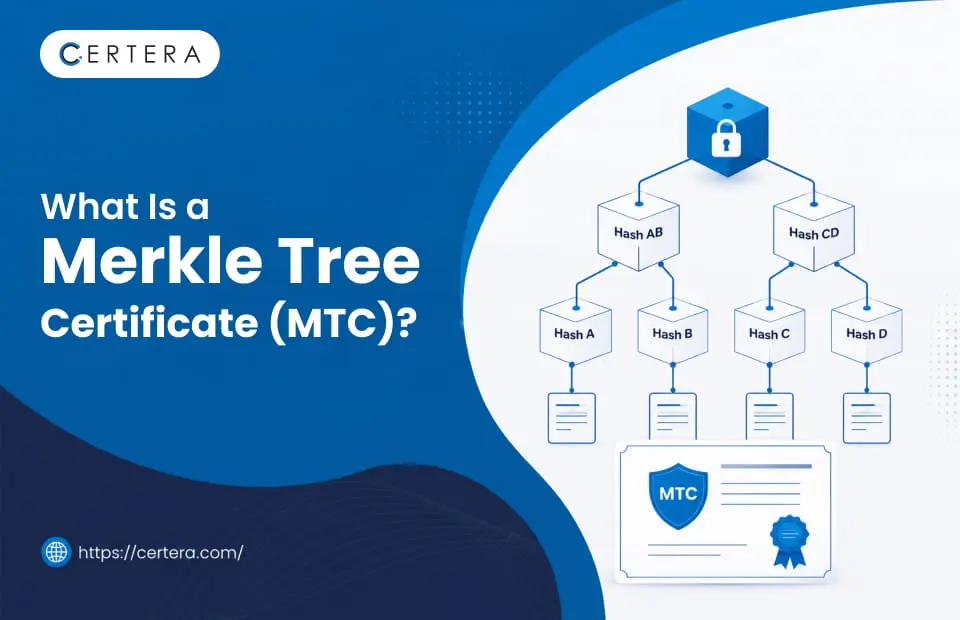
A Merkle tree is constructed by repeatedly hashing data until a single root hash remains.
For example, suppose four certificate records are represented as:
Certificate A → Hash A
Certificate B → Hash B
Certificate C → Hash C
Certificate D → Hash D
The hashes are paired and hashed again:
Hash A + Hash B → Hash AB
Hash C + Hash D → Hash CD
The resulting hashes are then combined:
Hash AB + Hash CD → Merkle RootThe meaning of the content is rewritten in a similar way.
Merkle root represents everything. If someone wants to check that Certificate B appears in the committed dataset, there is no need to collect all the certificates. The hash of Certificate B can be used, along with the relevant sibling hashes, to calculate the Merkle root independently.
If the computed root matches the trusted one, the status of the certificate can be confirmed.
This technique is called Merkle proof or inclusion proof.
How to Verify a Merkle Tree Certificate?
Verification generally involves the following steps:
- Obtain the certificate or certificate-related record.
- Calculate its cryptographic hash using the algorithm specified by the MTC.
- Obtain the Merkle proof associated with that record.
- Combine the hash with the supplied sibling hashes in the correct order.
- Calculate the resulting parent hashes until reaching the root.
- Compare the calculated root with the trusted Merkle root.
- Validate the associated cryptographic signatures or trust information, where applicable.
A successful match demonstrates that the supplied data is consistent with the committed Merkle tree.
Verification should also consider metadata such as the hash algorithm, tree construction rules, certificate identifiers, signatures, timestamps, and the source from which the trusted Merkle root was obtained.
Merkle Tree Certificate Example
Consider a certificate inventory containing four certificates:
| Certificate | Hash |
| cert-01 | H1 |
| cert-02 | H2 |
| cert-03 | H3 |
| cert-04 | H4 |
The tree could be constructed as:
Merkle Root
/ \
H12 H34
/ \ / \
H1 H2 H3 H4
To verify cert-02, the verifier needs:
- The certificate data for cert-02
- Its calculated hash H2
- The sibling hash H1
- The other branch hash H34
- The rules required to combine the hashes
The verifier calculates:
H2 + H1 → H12
and then:
H12 + H34 → Merkle Root
If the resulting root equals the trusted root, the record can be verified as part of that particular Merkle tree.
How Are MTCs Generated?
Creating a Merkle Tree Certificate or the relevant Merkle structure usually consists of multiple steps:
Gather the Information
First of all, it is necessary to collect the relevant records.
The data may include the certificate identification numbers, public keys, certificate metadata, validity details, information related to any revocation, etc.
Keep a Standard Representation of Data
Since it is important to standardize the data usage and representation; otherwise, different representations may lead to different results.
Obtain Leaf Hashes
Every single record will be processed according to the chosen hash function.
At this point, the hashes will be converted into the leaf nodes of the Merkle tree.
Build the Tree
The leaf hashes will be combined in pairs and hashed recursively until only one value remains.
Set a Safety for Root
This value should be obtained in a trusted way. The method may include the usage of digital signatures or any other trustworthy methods for identification.
Generate Proofs
Now the system is able to create proofs of inclusion for its records.
How Are MTCs Stored and Distributed?
The specific implementation of MTC determines the distribution and storage scheme.
Commonly, the architecture stores data in several elements:
- Certificate or Certificate Record: particular data that is verified.
- Merkle Proof: required hashes to prove inclusion.
- Merkle Root: concise commitment that represents the tree.
- Verification Data: data that makes it possible for the verifier to verify the trustworthiness of the root.
Merkle roots can be maintained in different systems, such as transparency services, databases, signed records, and certificate managers.
Underlying certificate records may not need to be sent with every verification request. The verifier can receive the relevant record with the Merkle proof and trusted root.
This makes verification through Merkle Tree certificates a viable option when working with large datasets.
Comparison Between MTCs and Traditional Integrity Mechanisms
Merkle Tree Certificates offer an alternative way of integrity verification when compared to standard practices.
| Method | Verification Approach | Scalability | Main Advantage |
| Single hash | Compare complete data against hash | Limited for large datasets | Simple integrity check |
| Digital signature | Verify signed data | Good | Authenticity and integrity |
| Hash chain | Verify sequential records | Moderate | Detects ordering changes |
| Merkle tree | Verify selected records using proofs | High | Efficient selective verification |
| Merkle Tree Certificate | Certificate data plus Merkle-based proof | High | Compact, verifiable certificate data |
A traditional hash can show that a certain piece of data remains intact; however, it may be necessary to have the entire data set to validate small information against a big one.
Using a Merkle tree solves this problem, as it provides simple proof of inclusion.
Digital signatures and Merkle trees do not contradict each other and can be used at the same time: a Merkle root can be signed digitally, providing an efficient way to prove membership and authenticate at the same time.
Uses of MTC
Structures that use Merkle trees can be used in different contexts in certification management and in the field of digital trust.
Certificate Transparency:
The Merkle structure can store large volumes of certificates and ensure full transparency.
Certificate Inventory Management:
Companies can create cryptographically secure certificates to make their inventories verifiable.
Certificate Lifecycle Auditing
MTC technology can be used to determine whether information was stored in a specified inventory.
Distributed Certificate Management
In case of distribution of the certificate-related information among various platforms, Merkle proof allows for quick verification of the records without the need to synchronize all databases.
Supply Chain Security:
Merkle trees enable information about the components of software to be stored and verified.
Digital Identity Systems
The technology can be applied for secure storage of data related to identities.
Large-scale PKI Infrastructure Development
The MTCs can be used in case there is a necessity to check the validity of large quantities of data.
A traditional hash can show that a certain piece of data remains intact; however, it may be necessary to have the entire data set for validating small information against a big one.
Using a Merkle tree solves this problem, as it provides simple proof of inclusion.
Digital signatures and Merkle trees do not contradict each other and can be used at the same time: a Merkle root can be signed digitally, providing an efficient way to prove membership and authenticate at the same time.
MTC Best Practices
It’s important to follow regulated practices for secure use of Merkle Tree Certificates.
Make Sure That You Use Modern Cryptographic Hash Functions
Make sure that you utilize well-known hash functions that have good security characteristics. Avoid old algorithms with known violations.
Define Canonical Data Formats
The representation of the information on the certificate has to be clearly defined. You need to plan how you will format everything, including field ordering, serialization, and encoding.
Keep the Merkle Root Protected
A Merkle root can be useful for a verifier only if it is trusted.
Keep Track of Version Details
It is critical to document the tree version, hash algorithm, construction method, and any other details that could help in the independent confirmation of the Merkle tree.
Use Automation for Generation and Verification
The use of automation plays a critical role in minimizing human errors, especially in the scenario of a huge certificate database or consistently changing data.
Keep Signing Keys Secure
In cases when Merkle roots and other records are digitally signed, it becomes important to secure the signing keys with proper controls for key management.
Retain Audit Records
It is also important to maintain enough historical data so as to reconstruct or check past Merkle roots and associated certificate states, in situations where auditing is necessary.
Regular Verification of the Proof
It becomes critical to perform regular testing of inclusion proofs, root validation, handling of bad inputs, and failure situations.
Common Merkle Tree Certificate Mistakes
While the Merkle tree is useful in ensuring security due to its properties of cryptographic integrity, improper use can weaken its effectiveness.
Utilization of Weak Hash Functions
The choice of an obsolete or inappropriate hash type may compromise the whole integrity mechanism.
Not Authenticating the Root
A verifier should be sure of the actuality of the Merkle root because if the root remains unauthenticated, then it would not be possible to have trust in its authenticity.
Inconsistent Data Encoding
In case two applications process the same data on a certificate differently, the results will most likely differ.
Ignoring Hash Order
The Merkle tree implementation should define what the order of hashes is. Otherwise, the implementation may create information that will be impossible to confirm.
Unacceptable Treatment of Odd Nodes
It is necessary to define how to handle the case where there is an odd number of nodes at one level of the tree.
Insufficient Key Security
If there is a need for digital signatures for the root or any other object connected with MTC, then if signing keys are compromised, there is difficulty in obtaining trust.
Assuming a Merkle Proof Proves Everything
An effective inclusion proof shows that the data in question is associated with a certain Merkle commitment. However, it does not automatically indicate that the relevant certificate is valid, trustworthy, not revoked, or active.
MTC verification should therefore be looked at as just one step in the process of validating a certificate.
Finally, Merkle Tree Certificates provide a simple yet effective cryptographic approach to verifying the integrity and membership of certificate-related information.
As the size of the certificate inventory increases and WebPKI processes become automated, Merkle technology can be useful for making the verification process easier and making the amount of data for every integrity check smaller.
Frequently Asked Questions
What data is included in the MTC?
A Merkle Tree Certificate contains information related to a certificate, information about the hash, the Merkle root, and the needed proof. Its structure depends on the provided implementation or specifications and may also have unique identifiers, metadata, signatures, timestamps, and algorithm information.
What Is a Merkle Tree?
Merkle tree is a hierarchical structure that makes use of cryptographic hashes in order to efficiently represent and validate large sets of data. The records are transformed into hashes known as leaf hashes and combined repeatedly until one hash–the Merkle root. This way, any change in the original record indicates a change in the root, which is a good way to detect changes in the data.
What Is a Merkle Proof?
Merkle proof is the collection of hashes that allows one to confirm that a given data record belongs to a Merkle tree without sharing the full tree. In this process, the user combines the given hash with the hashes of the other records, thus allowing him or her to find the Merkle root and determine whether it equals the value of a known root.
What is the difference between Merkle Tree Certificates and Digital Certificates?
A digital certificate is a method to link an identity with a public key, and it is usually issued by an authorized certificate authority. Merkle Tree Certificate is a type of certificate using the technology of Merkle trees to solve the issues of providing reliable information in a cryptographically verified manner. They have different functions and could be regarded as complementary goods rather than substitutes.
What is the Difference between Merkle Tree Certificates and Digital Signatures?
A digital signature is a tool for proving the author of the signed data with the help of a private key. Merkle Tree Certificate acts as a source of an accurate representation of the Merkle structure data. In this case, a Merkle Tree Certificate may have a digital signature confirming the Merkle root.
What’s the Difference between Merkle Proofs and Merkle Tree Certificates?
Merkle proof represents the method of proof that allows proving that data belongs to a certain Merkle tree. Merkle Tree Certificate, in its turn, can be treated as an advanced certificate for data confirmation, which can contain information required for establishing confirmation relations. Thus, a Merkle proof can be a part of the Merkle Tree Certificate.
Which Cryptographic Algorithms can be put to use by MTCs?
The cloud hash function applied would depend on the underlying MTC design specifications. In principle, more recent hash functions fit the criteria for Merkle tree construction i.e., SHA-256. The hash function used in practice must conform to the particular specifications, but it is not recommended to resort to obsolete or weak hash algorithms when creating MTCs.
What is the Status of MTC Specifications?
The status of MTC specifications varies depending on the concrete standard or Internet-Draft being used. Given that specifications can vary in the course of standardization, those seeking to implement the standards should rely on the most recent documentation published by the regulatory body such as IETF rather than on the unpublished drafts or secondary documents.