Simplify your PKI Certificate Management & Get Ready for 47-Day Lifespan

SSL Automation with Sectigo & DigiCert ACME Certificates
As SSL certificate lifespans continue to get shorter, managing certificates manually is no longer practical. Tracking renewals with spreadsheets or calendar reminders increases the risk of expired certificates, website downtime, browser warnings, and security issues.
With ACME based automation or AutoInstall SSL from Sectigo and DigiCert, certificates are issued, installed, and renewed automatically, helping keep your websites and apps secure without constant manual effort.
Today's enterprise environments require automated certificate management to keep pace with growing infrastructure. SSL Automation simplify the entire certificate lifecycle by automating issuance, renewal, installation, and monitoring, reducing administrative work while improving security and compliance.
Here's what that means for you:

Set-and-Forget
No more manual cycle of requesting, validating, issuing, and installing certificates. ACME handles it all automatically. Your team gets time back, and your infrastructure stays secure.

Automatic Renewals
Expired certificates are one of the easiest ways to break trust (and your website). With automatic renewals, your certificates update before they expire, no tracking, no alerts, no surprises.

Ready for Short-Lived Certs
The industry is moving toward 47-day SSL means 8x more renewals per year. It continuously rotates certificates, keeping you compliant without lifting a finger.

Multiple Options to Automate
We offer multiple options such as AutoInstall SSL®, ACME and CLM software to fit a wide variety of website hosting environments & enterprise needs.
Automated SSL/TLS Certificates
| Product | Lowest Price | Secures | Issuance Time | |
|---|---|---|---|---|
| RapidSSL + Automation Plan | $19.99/yr Save 26% | Single Domain with Automation | In Minutes | |
| Sectigo ACME DV SSL Certificate | $29.99/yr Save 57% | 1 FQDN (www + non-www) | In Minutes | |
| GeoTrust SSL + Automation Plan | $79.99/yr Save 15% | Single Domain with Automation | In Minutes | |
| RapidSSL Wildcard + Automation Plan | $139.99/yr Save 22% | All Sub-Domains + Automation | In Minutes | |
| GeoTrust Wildcard + Automation Plan | $289.99/yr Save 15% | All Sub-Domains + Automation | In Minutes |
Multiple SSL Automation That Fits Your Infrastructure
SSL automation is not optional anymore. It is business critical. Find the right SSL automation solution for your setup and avoid overpaying but still stay future ready.
| AutoInstall SSL® (for Linux & Windows) | ACME-Enabled SSL Certificates | Certificate Lifecycle Management Platforms |
|---|---|---|
| Ideal for VPS, cloud & dedicated servers | Ideal for developers & custom integrations | Ideal for enterprises managing 100s of certificates |
| Easy one-line setup (quick installation) | Uses ACME protocol for end-to-end automation | Centralized dashboard for all certificates |
| Supports Linux (Apache, NGINX) & Windows (IIS) | Works with Kubernetes, Linux, Windows, cPanel, Plesk | Automates discovery, issuance, renewal & revocation |
| Full lifecycle automation (issue, install, renew) | Compatible with multiple ACME agents | Supports all SSL types across complex infrastructures |
| Built-in alerts & minimal manual work | Fast setup with pre-built automation tools | Reduces manual workload with scalable automation |
| Buy Now | Buy Now | Get a Quote |
How ACME Simplifies SSL Certificate Management
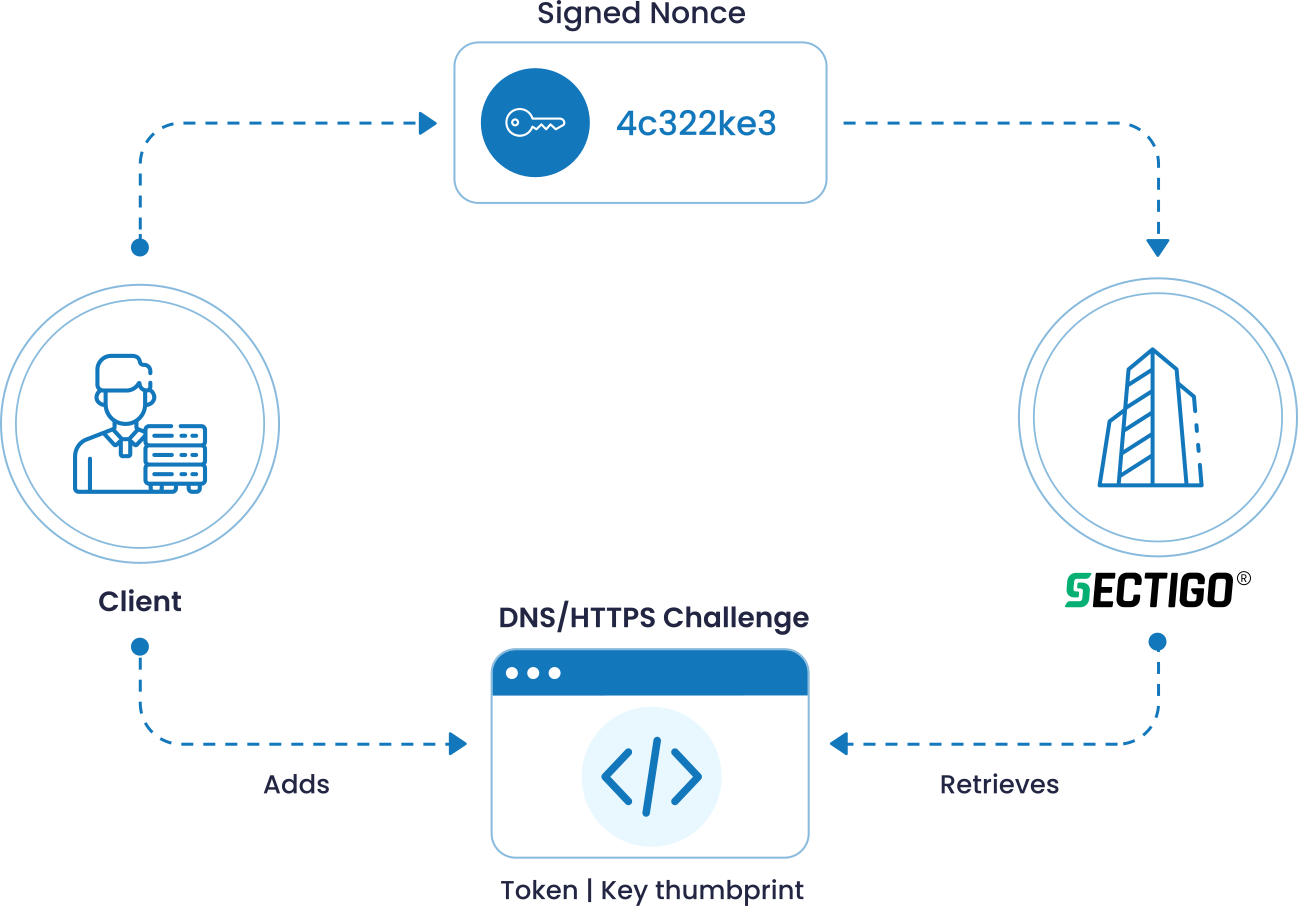
ACME removes the manual handling of the complexity of the process of handling the SSL certificate by providing a standardised and automated process. Servers can perform the entire lifecycle, including issuance and renewal, independently without human intervention, instead of manually requesting, validating, and renewing certificates.
Here’s how the ACME process works:
- Client Setup: Install an ACME client (e.g. Certbot, acme.sh, etc), create keys and set up your domain.
- Registration: The client signs up with Sectigo/DigiCert for a secure account.
- Request: A certificate request (CSR + domain) is sent to Certificate Authority.
- Validation: Domain ownership is checked with the use of HTTP, DNS, or TLS challenges.
- Issuance: After verification, CA issues the certificate with required EAB credentials.
- Deployment: HTTPS is automatically installed and configured by the client.
- Auto-Renewal: Certificates are automatically renewed before expiry, and no manual effort is required.
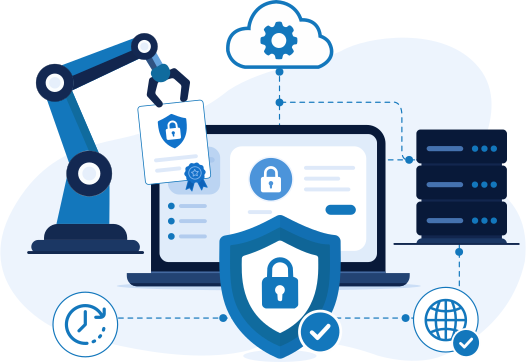
How AutoInstall SSL Handles the Shift to 47 Day Certificate Validity
AutoInstall SSL is an automated SSL certificate management solution that eliminates the manual work involved in securing websites. It is designed for organizations that want to simplify SSL management and ensure continuous HTTPS protection without ongoing maintenance.
Once Configured, AutoInstall SSL can:
- Automatically validate domain ownership
- Issue SSL certificates
- Install certificates on supported servers
- Deploy updates when certificates are renewed
- Renew certificates before expiration
- Help prevent website downtime caused by expired SSL certificates
How AIS Works?
- Install the agent with single copy-paste command.
- Authenticate with your token and verify your domain.
- It auto-generates CSRs, completes validation, and installs and renews certificates.
Supported Platforms:



ACME Certificates Features
- Eliminate the Risk of Expired Certificate
- Per-Domain Billing, Annual Subscription
- No Manual CSR or File Uploads
- Auto-renews before Expiry
- Shorter Lifespan (47-day SSL) Ready
- Massive Coverage Supports
- Unlimited Server Installations
- HTTP/DNS Challenges for Validation
- $500,000 Warranty
Automation Advantages That Simplify Your Infrastructure
![Enhanced Security and Trustworthiness]() Enhanced Security and Trustworthiness
Enhanced Security and Trustworthiness
 Enhanced Security and Trustworthiness
Automated renewals eliminate the chance of an expired certificate, which creates a potential for loss of access (website will go offline) or receiving a security warning (on a credit card payment). Automation also guarantees ongoing encrypted transactions and secure communication with customers.
![Elimination of Administrative Burden]() Elimination of Administrative Burden
Elimination of Administrative Burden
 Elimination of Administrative Burden
Management of certificates manually may take several hours and is prone to error. ACME Cert provides a simplified certificate process that allows IT to focus on longer-term strategic efforts instead of simply manually completing repeated tasks.
![Cost Reduction and Increased Efficiency]() Cost Reduction and Increased Efficiency
Cost Reduction and Increased Efficiency
 Cost Reduction and Increased Efficiency
Automation has reduced the need for extensive manual monitoring and the associated administrative resources, resulting in cost savings and increased operational efficiency.
![Future-Ready & Crypto-Agile]() Future-Ready & Crypto-Agile
Future-Ready & Crypto-Agile
 Future-Ready & Crypto-Agile
With industry trends related to shorter certificate lifespans (even 47-day), it is imperative that ACME's certificate capabilities enable organisations to renew their certificates on a regular basis without increasing their workload.
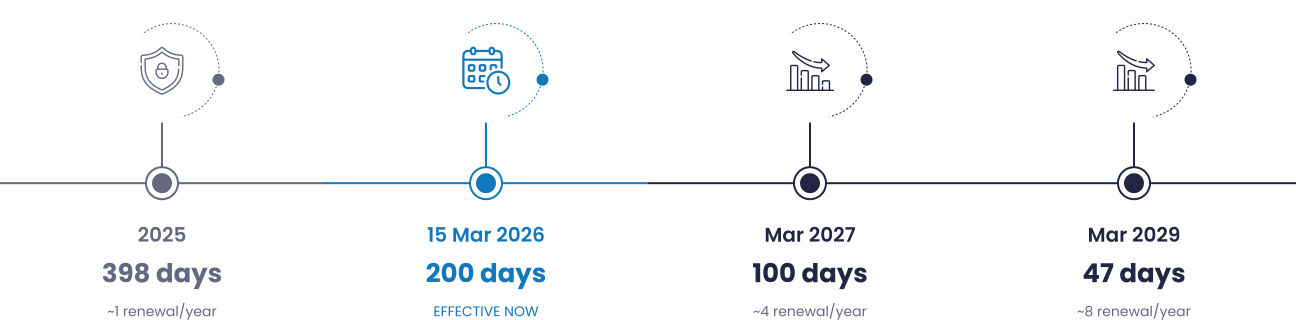
200-Day Validity Is Already in Practice
SSL validity is shrinking fast. Automation is the only way to keep your business running and stay ahead of outages.
ACME SSL Certificates vs Traditional SSL Certificates: What’s the Difference?
ACME offers a "set-and-forget" approach that simplifies certificate management while improving reliability.
| ACME SSL Certificates | Features | Traditional SSL Certificates |
|---|---|---|
| Automated | Installation | Manual |
| Automatic | Renewal | Manual tracking required |
| Highly scalable | Scalability | Complex for large environments |
| Minimal | Risk of Expiry | Higher risk due to manual oversight |
| Rapid | Deployment Speed | Time-consuming |
Frequently Asked Questions
Have Questions? We're here to help.
What is Sectigo ACME Certificate as a Service (CaaS)?
Sectigo ACME Certificate as a Service (CaaS) offers automated certificate management with the ACME protocol, based on the use of an SSL/TLS certificate. It also eases the issuance, deployment, renewal, and revocation of certificates, aiding organisations to have secure HTTPS connections without requiring manual certificate management.
What is Autoinstall SSL?
AutoInstall SSL® is an automation tool that automates the entire lifecycle of SSL/TLS certificates including enrollment, validation, installation, and renewal to eliminate manual management and prevent site downtime due to expiration. It automatically renews certificates, often 28-30 days before expiration, and installs them directly on the server without requiring IT person.
What are the SSL Certificate Automation Options?
There are multiple ways for SSL automation such as ACME-based automation (CaaS), Hosting control panels (AutoInstall SSL), Enterprise certificate management platforms (CLM Tools). They differ based on how much control you want and your hosting environment.
What is ACME used for?
ACME automates the process of the lifecycle of the certificates of the SSL/TLS, including issuing, domain verification, renewing and deploying certificates. It enables lessening the amount of manual labour, avoids the problem of expiration of certificates, and provides the continuity of reliable communication of websites and applications.
Which clients are available in ACME?
One of the clients that Sectigo ACME collaborates with includes Certbot, acme.sh, LEGO, Win-ACME, and Posh-ACME, more. Such clients contact the certificate authority so that they can request, install and renew the SSL certificates automatically.
What are the ACME Versions, Version in use?
The IETF defines ACME, and the latest popular version is ACME v2 (RFC 8555). This version embraces the current features, including wildcard certificates, enhanced authentication procedures and greater automation.
Are there firewalls or internal networks on which ACME can be used to certify?
Yes, ACME may be employed to certify behind firewalls or on internal networks. Through such techniques as DNS-based validation, organisations can determine the ownership of domains without having internal systems open to the internet.
Do I have to manually set up ACME each time I add a new domain?
Nay, when ACME is correctly set up, it is capable of automatically processing certificate requests and renewals. When making a new addition to the domain, the minimal configuration may be required, and beyond that, the automation will take care of the certificate lifecycle.
What Type of ACME Challenge Would I?
The usual types of ACME challenges comprise: HTTP-01, DNS-01, and TLS-ALPN-01. HTTP-01 is the best to use with the standard web server, DNS-01 is most effective with wildcard, and TLS-ALPN-01 is used to validate with TLS connections.
What is EAB (External Account Binding)?
External Account Binding (EAB) interconnects an ACME client account and a certificate authority account. It makes sure that only authorised users are able to request certificates from a particular ACME service, enhancing control and security.
Multi-domains or Wildcard Supports?
Yes, based on the setup, ACME certificates may be used to support multi-domain (SAN) and wildcard domains. This enables organisations to gain access to several areas or all sub-areas of a domain through automated certificate management.
Does ACME keep my private keys?
No, ACME does not save your personal keys. The generation and storage of the private keys is done locally on your server or system. The ACME protocol simply manages the certificate requests, validation and communication with the certificate authority.